


Foreword
The voices and artists in Ending Isolation explode off the pages with a terrifying beauty and rage as each writer describes, bears witness to, analyzes, and actually fights to survive the torture and suffering of solitary confinement.
Every incarcerated person is a whole human being, with a history, a mind, a soul, and a reality that existed long before their imprisonment. No one is defined solely by their crime. Yet the dehumanization, criminalization, and unchecked use of power have allowed the prison system to isolate more than 200,000 people on any given day (the number is likely much higher, since the documented number does not include the many now held in ICE detention centers, and some states don’t even record the numbers in solitary).Solitary confinement aims to destroy the humanity of the person subjected to it.
The following selections, written by men and women from different prisons across the United States, reflect short and long stays in solitary. Surviving solitary confinement and resisting it takes every fiber of one’s being. Bearing witness to one’s own suffering is an act of resistance.Reading these accounts and recognizing the people behind them is a vital first step toward understanding the urgency of ending this extreme form of punishment.
My own experience with solitary confinement changed mefor life. In the late 1980s, I spent eight months in solitary at FCI Tucson, followed by 22 months in an experimental isolation unit at Lexington HighSecurity Unit in Lexington, KY, ten months in the first complete maximum-security unit, and other shorter periods over the next several years.
In 2014, I was asked to give testimony to a congressional committee investigating the use of solitary confinement. This isa piece of what I said: “Imagine living in a space the size of your bath room and never being able to leave it. On top of that, imagine living in that space and having absolutely no capacity to have anything that you need without engaging in a hostile interaction with someone on the other side of the door that either hates you or is afraid of you or doesn’t view you as a full human being.Imagine that you have nothing to do except live through the time where only your mind is working. No distractions and no contact. What happens over time is that you lose pieces of yourself. Your memory, your physical relationship to time, your circadian rhythms that are so important to your mental and physical health quickly deteriorate. In order to get water to drink or toilet paper to use, or food to eat, or have any human contact of any kind you have to scream and yell for attention and then you have to communicate through a steel door.It makes one rage. One is constantly on high alert in order to be prepared for something hostile to happen. It is like being in a war that never ends. The fight or flight reaction gives over to traumatic stress that only intensifies the mental anguish of the isolation. In the case of solitary confinement, one exists in a state of nothingness. And that nothingness comes from loss. What is lost? The power of self-determination, the power of control over aspects of your life, a sense of purpose, your relationships to the outside, your commitments to family, your obligations/responsibilities to all the connections of your past life, your own agency, a human connection to the natural world—the seasons—the rhythms of being alive, your memory, and with time and age and lack of care or pure neglect you lose control over your own body. It is existential death.”
Heaping punishment and torture on our fellow humans isno way to treat people.
American punishment is rooted in slavery, control, profit, and the fundamental oppressions created by the unjust, inequitable, white supremacist, misogynist system. It has expanded and multiplied and there are now several million people incarcerated in prisons and related institutions. ICE detention centers have taken the worst practices of the U.S.prison system and rendered humans even more invisible than those currently being incarcerated. As the carceral system expands, so does the human suffering. This zine, and the stories in Ending Isolation, exposes the terrible human cost of this inhuman and targeted form of destructive punishment.
Susan Rosenberg, Former Political Prisoner
Susan Rosenberg is a human rights and prisoners rights advocate, adjunct lecturer, award-winning writer, speaker, and a former prisoner. Her memoir, An American Radical, details her 16+ years in federal prison and her conclusions about her prison experience. She was released from prison in 2001 through executive clemency. Susan has worked in nonprofit communications on human rights and in defense of prisoners and the abolition of prisons. She worked on the freedom campaign of Dr. Mutulu Shakur, who was released from federal prison in 2022. She lives in NYC.
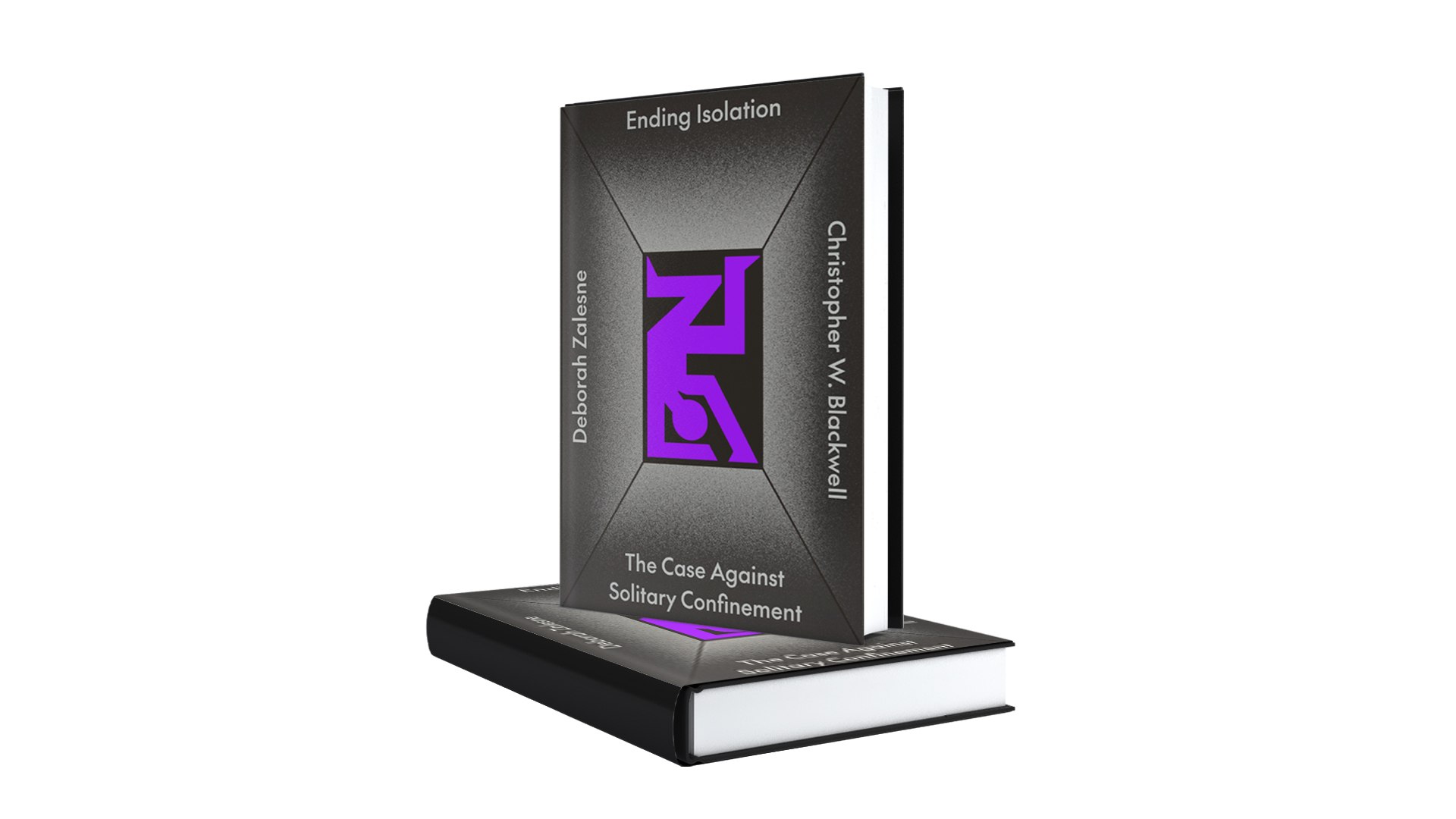
This Zine Compilation is composed of excerpts from “Ending Isolation: The Case Against Solitary Confinement,” a book involving a very exciting collaboration between not only the named authors—Chris Blackwell and Deborah Zalesne with Kwaneta Harris and Terry Kupers—but also over thirty incarcerated and formerly incarcerated individuals who have experienced the horrors of solitary confinement.

“Let’s go, you know the drill!” a guard yells. I’m sitting in a tiny concrete cell as two guards begin the intake process of placing me in the hole, in solitary confinement. I know they will take everything in my possession, but I’m desperate to keep my phone book and photos of loved ones.
I remove my socks and shoes. My naked feet come into contact with the cold and filthy concrete floor, bits of dirt and grime and other prisoners’ bodily fluids sticking to my skin.
Though I have no choice but to comply, I hate myself for it. I strip all the way down. Once I’m fully naked, the guards look me up and down, and it takes all the strength I have to hold my head high, but I do. All I have left is my pride.
One of the guards looks at me and says, “Run your hands through your hair and shake it out. Now bend your ears so I can look behind them. Open your mouth. Run your finger through your gum lines. Now lift your arms, now your nuts. Turn around and bend over, spread ’em and cough. OK, let me see the bottoms of your feet. Get dressed.” The guard barking at me is emotionless in his commands.
Through the slot, the guard throws a worn-out orange jumpsuit and a roll of pink underclothes into my cell. I get dressed as quickly as I can, brimming with frustration and loathing; all the work I’ve done to transform myself into someone positive feels as if it might be erased. No one will tell me why I’ve been brought into solitary. I was simply cuffed and taken without explanation.
I wake to the sight of a man staring through my cell window. He tells me that he’s my counselor, here to do an initial review on why I’m here.
Maybe I can finally defend myself. The counselor stops me when I start to ask questions and instead begins to read from the paper in front of him. He sounds like a robot, and I realize this is just another formality.
“Mr. Blackwell, you have been placed in administrative segregation under investigation for suspected gang activity.” (Administrative segregation is used for protective custody or when an investigation is pending, as opposed to disciplinary segregation, which is used to punish a prisoner for a rule violation or infraction—but both are forms of solitary confinement and the conditions are generally the same even when solitary confinement is not being used as a punishment.) He looks at me and asks if I understand what that is.
“I do. But why? I’m not a gang member.”
“Blackwell, I am surprised too,” he looked at me and said, “But it says here to take you to IMU and you are under investigation for STG [security threat group] activity.”
When he said this, I was even more confused than before.
They were saying that I was suspected of being involved with an active gang. Here is why I was so shocked: I have never been a part of a gang nor would I ever be. I have done a whole lot in my life, but never have I wanted to be in a gang. This is true for my time inside of prison and out on the streets. Not to mention, I was 36 years old at the time of this extraction, and I would have looked quite foolish trying to act like a gang member at that point in my life.
The counselor goes on to tell me that he doesn’t know any details, that he’s only here to inform me of what the paper says. I lose all hope of anything productive coming from this conversation.
“Your next two reviews will be on July 26 and August…” I look at him with shock. It’s June now.
Christopher Blackwell
DOC #813709
Washington Corrections Center
“Ending Isolation: The Case Against Solitary Confinement,” pages x, 25-26.
Originally published in Narratively, March 27, 2024.

Take a moment and try to imagine being placed in a box the size of a small bathroom. You’re stuck in this box for at least 90 straight days, and you’re allowed to leave this box for an hour once a day. When you are in that box you can’t talk to other people because of strategic structural restrictions. On top of that, imagine you have a history of being inflicted with a mild case of claustrophobia.
Confinement in the box is like being buried alive. Picture yourself being placed in a coffin with its lid nailed shut. Your ability to move is restricted by the coffin’s walls. The coffin is placed in a hole in the ground, covered with mounds of dirt. There is no escape, even when a hyperventilating sensation starts to consume your very being, demanding that you flee such mind-torturing claustrophobia, and those who put you there give you just enough food and water to keep you alive. The only difference between the box and the coffin is the size of the container; one is a bit smaller than the other.
John “Divine G” Whitfield
(portrayed in the movie SingSing by Colman Domingo).
divinegentertainment@gmail.com
“Ending Isolation: The Case Against Solitary Confinement,”
My cell was at the far end of the tier. It had a stainless steel combination toilet/sink, a steel desk with a built-in stool, and a steel slab bolted to the wall with a thin mattress for a bed. It had a steel door with a feed slot, and the window was covered with steel plate. Since I was in a corner cell, two of the walls had steel plate. Since it was so cold outside, the steel plate held the cold and made the cell feel like a refrigerator. For at least the first month there I wasn’t allowed a change of clothes, even on shower days. Once a week or so, I was allowed to have an orderly wash my clothes. I would strip, turn my clothes over to the orderly, and lay under my blanket until I got my clothes back. That made for some uncomfortable interactions with corrections staff if they came to my cell when my clothes were being washed.
marc.ramirez@live.law.cuny.edu
“Ending Isolation: The Case Against Solitary Confinement,” page 9.

I questioned many things while in solitary—relationships, family, loved ones, society. But most of all my place amongst them. My relationships with them. Do they matter? Do I matter? Does my life matter? As human beings we are meant to interact with one another, to care for one another, to be compassionate, to learn from one another. That’s what makes us human. Our interconnectedness to one another. That’s what gives life meaning. As I have grown I’ve learned that these are essential in life; otherwise we wither away. In solitary, I was deprived of these things—these essentials of life—and I withered. I was 18 when I was stripped of humanity.
Matthew J. Murphy
“Ending Isolation: The Case Against Solitary Confinement,” page 13.
My family doesn’t understand when I explain that mymemories of my time in solitary are blurred. They have months or years ofdistinct memories. In solitary, I only had one. Each day was the same, andbegan with the worst part: waking up. “Nothing” happens each moment of everyday. Yet in those moments of nothingness, the absence of life, happiness, and experience gives birth to misery and despair—the torture of knowing that your life is worth nothing, that it holds nothing: no casual conversations with a neighbor or coworker, no hugs from friends and family, no kisses from a spouse. There is nothing left but bare survival.
Aaron Olson (DOC # 327076)
Washington Corrections Center
“Ending Isolation: The Case Against Solitary Confinement,” page 14.
Originally published in Jewish Currents, April 20, 2023.
Though we spend 23–24 hours of the day with only bright lights, loud noises, and smells of unwashed bodies to accompany the complete isolation, we walk past general population on the rare excursion to the medical building, which involves a strip search, handcuffs, ankle shackles, and a belly chain. As we’re escorted, our peers in General Population are ordered to “Catcha wall!”—prison lingo demanding everyone turn their backs to us. Per policy, making eye contact or speaking to us is punishable as a disciplinary infraction. Breaking this rule often results in the person joining us in TheBox, effectively criminalizing all human emotions, concern, contact, and love for other prisoners, especially those in isolation.
People are sent here for the tiniest of infractions. Loretta’s father died recently, and she was discovered in her ex-girlfriend’s cell thirty minutes after hearing the news—the Sergeant I spoke to said they were just sitting on the bed crying. Because that’s against the rules, they put her in solitary. Loretta has a nonviolent crime and, with only a year left on her sentence, she would have been eligible to attend her dad’s funeral. Now, with this disciplinary, not only is she ineligible, but she won’t even have phone access for sixty days.
Kwaneta Harris (DOC #01605894)
Lane Murray Unit, Texas
“Ending Isolation: The Case Against Solitary Confinement,” page 31.
Originally published in Scalawag, May 30, 2024.
Texas prison is a brutal place to serve time. Most of the world knows this by watching how frequently executions are carried out. What the majority of the world doesn’t know is that the Texas execution chamber is not limited to the room where condemned prisoners are killed. Conversely, the state’s prison system operates a massive—mostly hidden, but equally deadly—extension of its main execution chamber that it calls RestrictedHousing, a fancy name for solitary confinement. On a daily basis, thousands of prisoners are subjected to a deadly three-ingredient cocktail of severe isolation, extremely deplorable living conditions, and inadequate mental and physical health care that results in cold-blooded state-sanctioned murder!
Personally, I have been subjected to severe retaliatory measures by Texas prison officials for my willingness to work with the media and expose the unchecked brutalities and inhumanities inside this agency. They have tossed me into long-term indefinite solitary confinement, transferred me to four different prisons in the past four months, destroyed all my personal property at least twice, and restricted me from using the tablet/phone until a few days ago.
Jeremy Busby (DOC #00881193)
Estelle Unit, Texas
“Ending Isolation: The Case Against Solitary Confinement,” page 48.

After an altercation with some guards, I was taken and placed in the isolation cell, after the guards roughed me up, of course. Once in the isolation cell, I was stripped of all my clothing. The isolation cell does not even have a mattress; it has a one-inch-thick rubber pad. The door to the recreation yard was opened to allow the winter air in. After this was done,the guards placed a fan in front of the door, turned it on high, and pointed itright at the isolation cell I was in. You have no clue how cold those next fewhours were… I had to earn my humanity back, clothing, and eventually a regularcell with a mattress.
Steven Nall
“Ending Isolation: The Case Against Solitary Confinement,” page 51.

I had been in segregation for some time and things between staff and me were pretty hostile. It was like a game of tit for tat. For example, they would deny me toilet paper and I would react by covering my windows with paper bags, blocking their view into my cell.
One day things escalated in a way I was unprepared for.I can’t remember what the guards had done to upset me but I had just finished covering my windows when I heard comments from staff that they were calling in the Quick Response Team. This usually meant that a group of male staff were putting on riot gear to come into my cell, tackle me, and put me in a padded room.
However, on this day, it wasn’t a padded room they took me to. Once they had tackled me to the floor, six men lifted me up and placed me onto a gurney. This was by no means a normal gurney that you would envision at a hospital. There were heavy straps all around it to secure my body down.They had straps on each of my arms and legs and one across the top of my chest.I can still remember the pressure of them all being secured so tight. I was trying to keep myself calm so that I wouldn’t hyperventilate, which would’ve made the situation so much worse.
I had no idea what was in store for me and was terrified that they had plans of moving me to another prison out of state or to a mental institution for long-term evaluation as a form of punishment. Oh how wrong I was.
They rolled me back into the dark cell and slammed the door shut behind me. I waited there for an hour before they came and rolled me back out. Instead of releasing me from the bed as I had expected, one of the guards asked me to pick a limb that they could untie for 45 seconds, allowing the blood to recirculate. I picked my left leg. They untied it and I was allowed to move and shake it around for less than a minute before they tied it up again and wheeled me back into the cell.
This went on for the rest of the day. Every hour they would wheel me out and let me pick a different body part to move around, then wheel me back into the cold room. I can remember the ache in my body from not being able to move. It was all consuming—the way my hands and arms would go numb from lack of circulation.
Throughout this whole process, no one ever talked to me except for when they asked me to pick a limb. It wasn’t until many hours later someone finally told me that they would release me off the bed, but before thatI had to sign a bunch of paperwork acknowledging that if I acted out again, I was getting strapped back to the gurney. In hindsight, I recognize this was away for them to control me, but at the time it just felt so inhumane, and I believe that if there had just been simple communication between the officers and me, there would’ve been no need for any of this.
Gail Brashear
gbrashear80@gmail.com
“Ending Isolation: The Case Against Solitary Confinement,” pages 55-56.


‘Mainline,’ the officer’s voice boomed, signaling prisoners to stand at their door if they wanted to be fed. I had just finished brushing my teeth and went to the yellow line that indicated exactly where to stand. The two officers delivered the trays one by one, with one officer pushing the cart and the other opening the slots to pass the food through. I could smell the eggs as the cart moved closer. After the officer handed the guy on the right side of my cell his tray, they bypassed my cell, handed the guy on the left side of my cell his tray, and then continued down the tier. They never looked in my direction. They never said a word.
Lunch arrived four hours later, and again I was skipped. As I lay in bed throughout the afternoon, all I could do was hope that the officers on the next shift were not in cahoots with this crew. Then I’d be able to eat dinner. I nodded off at some point and awoke when a different voice boomed, ‘Mainline.’ I jumped out of bed, rushed to the yellow line, and waited. The guy on the right side of me got his tray, then the officers stopped in front of my cell. When one of them opened the slot on my door to pass me the tray, I felt so relieved. My relief turned to rage when he shoved the tray so forcefully the food flew all over the floor. The slot then quickly closed and the two continued passing out meals as if nothing out of the ordinary had occurred.
I ate that spaghetti right off the floor, and scraped the applesauce off the wall with my hand, licking it off my fingers. Of course,I waited until my tormentors left the tier lest they get to enjoy bearing witness to the spectacle. When they returned to pick up my tray, I handed it to them as if nothing out of the ordinary had occurred. My face showed no emotion. I said not one word.
This day replayed itself twenty-one times. No breakfast, no lunch. Dinner eaten off the wall and the floor. For twenty-one days I was never let out of that cell. No shower. No telephone. There was nothing I could do about it.
Jeremiah Bourgeois
“Ending Isolation: The Case Against Solitary Confinement,” pages 58-59 .

After I read a graphic novel titled Amazons,Abolitionists, and Activists: A Graphic History of Women’s Fight for TheirRights by Mikki Kendall and A. D’Amico, I knew I would violate prison rules.
This prison promotes an anti-reading environment. “Traffic and Trade” is the disciplinary infraction issued for sharing personal property such as books, magazines, or shampoo with other incarcerated people. But I wanted these mostly young women to see what we’ve accomplished throughout history—to know that being a woman isn’t a curse. It left me inspired and wondering: what will my contribution be? Many women in solitary with me have been locked up since childhood.
The complex dance begins. As a team, my neighbors stick mirrors out windows to watch for guards.
I secure the book in a sock attached to several connecting shoestrings and dangle it out my window. Waiting for the signal, I swing the heavy sock five cells to my right. It reaches a first-floor window where it’s grabbed and passed from outstretched hand to outstretched hand until it reaches its intended recipient. Days pass as the book makes the rounds to all 228 people in solitary.
Then: a message. The book has been confiscated. A tallBlack woman guard sashays up the stairs wearing a smirk and fanning my book. I stand at my cell door turning my ID over and over in my hand, waiting for her to collect it for my disciplinary. She flips through the pages and asks,
“Dis yours?”
“Yes,” I say.
“Yes what?” she snarls.
“Yes Ma’am,” I answer to the woman who is the same age as my son. I just want her to write the disciplinary order and leave me alone. Instead, she tells me that because of its “radical content,” the book could promote a riot.
Anger floods me but I remain silent. This guard is known for antagonizing people. She wants an argument, but only the youth argue with the guards. She says she is giving me a warning and waits for an apology from me, her weight shifted to one leg. Instead, I say, “Write me up,” as I take the three steps to my bed. The dorm is listening. At 51, whether I like it or not, I am a role model. Security staff usually describe me as an “old school – no problem inmate.” I have to demonstrate the value of education, to show by my actions that there are times you must stand unapologetically for the right to know. Consequences be damned.
A new neighbor arrives and asks me through our shared vent, “Excuse me, I don’t know how long Imma be down here for refusing to work. Can I borrow a book?”
“Sure,” I answer. “Go to your window.”
Kwaneta Harris (DOC #01605894)
Lane Murray Unit, Texas
“Ending Isolation: The Case Against Solitary Confinement,” pages 85-87 .
Originally published in The Emancipator, October 2, 2023.

You see these women as they reach for their water with all these scars wrapped around their arms and you think, “My God, what made you mutilate yourself like this?” The answer is simple though. Time, unresolved issues, and last but not least isolation. Those three combined can be deadly.Literally.
The first time I tried taking my life in prison was the closest I’ve ever come to death—not counting the many times before prison. Afterwards, I woke up to the mental health counselors asking, “Why didn’t you just ask for help, Potts?”
See, the thing is, getting mental help in prison isn’t exactly helpful. If anything, it’s humiliating. First you have to tell a guard you’d like to speak to mental health. Then when you step into their office you have to be careful and not say certain words like “I can’t handle this” or “I feel hopeless.” Things like that could put you on CDO (Continuous DirectObservation).
CDO is when you’re moved to solitary confinement, stripped of all clothes, and placed in a one-person cell to be closely monitored by a guard. Every 24 hours that same mental health counselor that deemed you unfit visits and gives you 3–5 minutes to convince her you aren’t suicidal or homicidal. She’ll either clear you or you remain CDO until you are transferred to Mountain View prison (nicknamed the “ice house” because of the freezing temperature inside), where they send incarcerated women in Texas for further evaluation—they put you in another empty one-person cell, totally naked, without property. Not even a ponytail holder.
In my case I skipped CDO and was sent directly to the icehouse after getting my wrists stitched up at the local hospital. I was put ass naked and shivering in an off-white colored cell with feces painted on the walls.
Ms. Teague, the ice house mental health manager, decides if you are cleared to return to your prison unit or, for more extreme cases, if you are eligible for Sky view, a long-term prison unit for mental health treatment. “Ms. Potts, are you ready to go back to your unit?”—hinting that Iover stayed my welcome.
Ms. Teague asked a few more questions like, “Are you having homicidal or suicidal thoughts?” The word “No” flew out of my mouth so fast, I thought she knew I was lying. I sat naked, balled up with my knees to my chest, shivering and hungry because the only thing on the menu is two sandwiches three times a day, hair matted, with wounds exposed to whatever else this filthy cell had on its floor and walls. Lucky for me, Ms. Teague didn’t care if I was lying or not. I was just one out of thirty other women she had to clear.
In no time a familiar officer from my prison approached my cell door with handcuffs and gown in hand. I looked at her confused because one wrist had nine stitches and the other had four. Still, she made me turn around and bend at an angle so I could stick my hands through the tray slot to get handcuffed. After the painful and uncomfortable ride “home,” they housed me in solitary confinement until a bed was available.
Isolated inside of another one-person cell, not being able to come out was the most dangerous time in my prison life. I can’t count how many times suicide crossed my mind—it would have been so easy to finish what I started. The guards fail to properly do rounds, only briefly flashing a light inside your cell without looking to see if you are breathing or bleeding. Here the real battle began for me. My suicidal thoughts increased and went into overdrive as buried memories and emotions started to resurface. The things I could usually push to the back of my mind with distractions were damn near impossible to avoid with nothing to do all day but think. The only thing stopping me from trying again was the fear of failing again and being sent back to the ice house and having to do it all over again.
Marissa Potts (DOC #17729426)
Lane Murray Unit, Texas
Texas
“Ending Isolation: The Case Against Solitary Confinement,” pages 79, 96-98.

The door slammed behind me. I looked across the room in confusion. This wasn’t a cell; it couldn’t be. There was no bed, no sink, and no toilet. There was a mattress thrown on the ground at the far end of the cell. And there was a smell. Sewage?
I looked at the floor. It was different, covered in a rubbery material instead of the bare refined concrete I’d grown accustomed to in my cell. In the center of the room there was a barred grate over a hole in the floor. I realized with horror that the cell had a toilet after all. It was like something from medieval times.
There is no polite way to tell this story. Imagine defecating through that barred grate in the middle of a floor. As disgusting as you imagine it, it’s worse. Your waste doesn’t simply fall through. It rests on top of the grate, leaving you with a choice no human should be forced to make: take the small individual squares of toilet paper they give you and push the feces through the grate into the hole, or live with the stench and horror of a log sitting in the middle of your floor like some unholy shrine. If you choose the former, like I did, you will want to be extra careful not to get any on your fingers. There is no sink to wash with, and the squares of toilet paper are perilously thin. Do not worry too much about what’s left along the edges of the bars. Soon enough you will urinate, and if your aim is good enough, you can blast the remaining matter away.
This was solitary in the Thurston County Juvenile Detention Facility in Olympia, Washington, in the 1990s. I was 14 years old.
Raymond Williams
raymond_m_w@icloud.com
“Ending Isolation: The Case Against Solitary Confinement,” page 109.
A version of this story was originally published in Jewish
Currents, April 20, 2023.
My stomach unleashed a deafening growl upon hearing theroll and rattle of an approaching food cart. Having spent the previous three out of fourteen days in isolation punishment at the Texas Department of Criminal Justice, I was famished. Up until that point, my meals had consisted solely of two bologna sandwiches.
A male officer’s face appeared at my cell door and smiled menacingly through the metal mesh grate as he opened the slot where the sandwiches are usually dropped, but today he produced a hot tray. Two steak-and-cheese-stuffed burritos from the officers’ dining hall sat in front of me, the prison equivalent of a five-star meal. My stomach roared in agreement to the aroma, then dropped as I heard the officer utter his demand.
“Get naked and dance for me and you can have it,” he sneered. Gaping at him, disbelief and hunger shone in my eyes as he added, “Or get nothing at all.” So I ate my fill that day, burning in shame.
Lanae Tipton (DOC # 50812018)
Lane Murray Unit, Texas
“Ending Isolation: The Case Against Solitary Confinement,” page 122.
I am still haunted by an act performed by my neighbor in order to save my life, which may sound extreme but is unfortunately not that uncommon. I have a peanut allergy, which can be deadly in solitary confinement because our 24-hour medical clinic is several buildings away and nobody has an EpiPen in the hole. People living in general population are permitted to keep non-habit-forming prescribed medication like Benadryl in their possession, but in isolation, all medications are dispensed only by a med tech.
Our meals arrive in solitary pre-made, so I can never be sure if there will be traces of peanut butter on my food. Once, when I felt that familiar tingle on my lips, I banged on the door to alert my neighbors (we have an in-cell emergency button that hasn’t worked since Clinton was in office). As the word spread, everyone was banging on their doors with cups and yelling out their windows. When a guard finally came, he walked right by my door. My neighbor Lay-Lay called him to her door to tell him I needed Benadryl. Then, I heard the unmistakable bang of the food tray slot in her door open. The guard was pressed against the door as Lay-Lay fished his penis out and briefly performed oral sex with a promise to finish once he returned with the Benadryl. My back was itching and my eyes were puffy when he threw a handful of Benadryl pills wrapped in toilet paper through my door gap on his way to Lay-Lay’s door. I will always be eternally grateful to Lay-Lay for saving my life. But I will never forgive the system for putting her on her knees to do it.
Kwaneta Harris
“Ending Isolation: The Case Against Solitary Confinement,” page 130-31.
A version of this story was originally published in The Marshall
Project, March 10, 2025.
Organizing
Antcraft and Antwork are my imaginative language to describe organizing. Ants are considered colonizers and as a super organism, they cooperate with the biosphere they occupy under some super-extraordinary circumstances. Ants can educate us—in a natural way—on how to colonize or occupy spaces on the ground and how to cooperate en masse. Imagine if prisoners were organized collectively like we organize separately in our siloed ecosystems, how much cultural and social capital we can Harambe (pull together) under the flag of freedom, justice, and equality in the spirit of Abolition.
Vincent “Tank” Sherrill (DOC #959738)
Coyote Ridge Corrections Center, Washington
“Ending Isolation: The Case Against Solitary Confinement,” pages 176-77 .
When you’ve been in the hole long enough, even your dreams take place in a cell. This will set in after about six months. You put a letter out through the slot in your cell door to mail it, then find the same letter sitting on your desk and realize you only mailed it in a dream. You dream of petty catastrophes—knocking your radio off the desk and breaking it, losing your only pen.
You dream, constantly, of fighting with the guards. Your cell door slides open and a squad of them rushes in to attack you, or you impulsively slip your handcuffs during an escort and punch one, incurring new rule infractions and extending your time in solitary. You wake with your chest cinching down on your lungs, panicking.
As the months of isolation proceed, it becomes increasingly difficult to distinguish dreams from reality. Then reality itself takes on a dreamlike texture. You drift between the sad little tasks you’ve invented to give your day a semblance of purpose—making your bed and stretching the threadbare wool blanket to a pristine smoothness, tucking and re-tucking the corners; cleaning the cement floor with a washcloth and soap; getting the edges of the papers on your desk lined up just so.
You forget what you’re doing as you’re doing it. Your brain’s neurons seem to sputter when they should be firing. To focus on anything for longer than a few minutes is impossible. Try to get a letter going, or read, or think along a linear course, and your thoughts turn to ether.
Your mind retreats into daydreams and your daydreams grow complex and immersive. They tug you along on a course of their own devising, heeding none of your direction. Invariably they involve conflict with someone—a real person from the life you once had or some imagined antagonist. You pace your cell reciting aloud the clever points you would make to these chimeras, issuing ultimatums to them. The daydreams are in no way pleasant, and altogether unwanted. They enrage you.
Kevin Light-Roth (DOC #812302)
Washington Corrections Center
“Ending Isolation: The Case Against Solitary Confinement,” page 14-15.
Originally published in The Small Bow, January 28, 2025.

Amari
A lover of books
Inquisitive and smart
Amari Selton
Had great heart
He spent years in a cell
Going through hell
Human dignity abused
Isolated and confused
Trapped in the labyrinth
Of his own mind
Psychosis and lucidity
Became intertwined
Quack psychologist
Jailhouse apologist
Psychotropic dichotomy
Chemical lobotomy
He’s far away now
Thousand yard stare
I keep looking
But nobodies there
Soul exhausted
Bereft of hope
Unable to cope
He made a rope
Attempts to resuscitate
Echo in the night
Stressful sounds
Release finally found
Of his name
Only memories remain
Sorrowful mothers pain
Lamentable refrain
Sean Ryan
(Contact through Sarah Schrading: sarah.schrading@live.law. cuny.edu)
“Ending Isolation: The Case Against Solitary Confinement,” pages 78-79.

Afterword
While many watered-down reforms lately would have us believe that solitary confinement doesn’t even exist in some states, that is completely false. Even states like New York, New Jersey, Washington, and many others that have claimed to remove solitary have not. Most states where these reforms have taken place have simply changed the name of what they call solitary confinement to things like Restorative Housing, Special Offender Units, or Intensive Management Units. But it doesn’t matter what it’s called—if you are isolated in a cell with nothing but your own thoughts for 20 plus hours a day, YOU ARE LIVING IN SOLITARY CONFINEMENT!
It’s also very important to recognize that solitary is not reserved for the so-called “worst of the worst.” Most often the people who end up in solitary are there for minor infractions, such as swearing at a guard after being told they are violating a simple prison rule, wearing a baseball hat in a building, or being deemed disruptive during a daily count.
Solitary has also become a regular for many incarcerated people who suffer from mental illness. Regardless of the fact that it is against their own policies, many states use solitary to warehouse people with mental disabilities, primarily because of an inadequate screening process. And once inside those cold lonely cells, people rarely receive the proper mental health treatment they require. Juveniles are also not meant to be placed in solitary, but when they are tried as adults, they are treated as adults!
Solitary confinement doesn’t just affect those who are forced to experience it. It also causes harm to communities, with benefit only to prison guards and administrators who are able to use it as a weapon to control and oppress those held within their care.
Many organizations across the country are fighting to end the use of this barbaric practice—a practice rooted in racism and abuse that was deemed by the United States Supreme Court over 200 years ago to be nothing short of torturous. Yet we still continue to allow our fellow citizens to be subjected to such conditions.
Our book, Ending Isolation, is a collaboration among four main authors (Deborah Zalesne and I wrote it with Kwaneta Harris andTerry Kupers), as well as three dozen individuals who spent time in isolation and were courageous enough to tell their stories at the risk of severe retaliation for reporting on the torture that is solitary confinement. Their stories, some of which are excerpted from Ending Isolation and compiled in this zine, provide a graphic taste of the harms of solitary confinement.
There is a saying I always use that’s centered around facilitating the change we want to see within the carceral system: When we humanize something, it becomes very difficult to demonize it. And that is our goal in this work—to humanize the hundreds of thousands of people sitting in solitary confinement today.
So I want to thank all of you who are participating in this fight, because without us moving as one collective body, there is no way we’ll ever accomplish our goal of putting an end to this torturous practice.
Christopher Blackwell
Incarcerated Journalist & Executive Director of Look2Justice
Email: christopherwilliamblackwell@gmail.com
Website: www.christopher-blackwell.com/contact
X: @ChrisWBlackwell
IG: @ChristopherWBlackwell
Bluesky: @chriswblackwell.bsky.social
Podcast: www.brokenisbeautifulpod.com/
Huge thanks to the currently and formerly incarcerated writers who made this zine compilation possible: John “Divine G” Whitfield, Marc Ramirez, Aaron Olson, Kwaneta Harris, Jeremy Busby, Gail Brashear, Jeremiah Bourgeois, Marissa Potts, Raymond Williams, Vincent “Tank” Sherrill, Lanae Tipton, Kevin Light-Roth, and Sean Ryan. May your stories shed light and an end to this brutal practice.
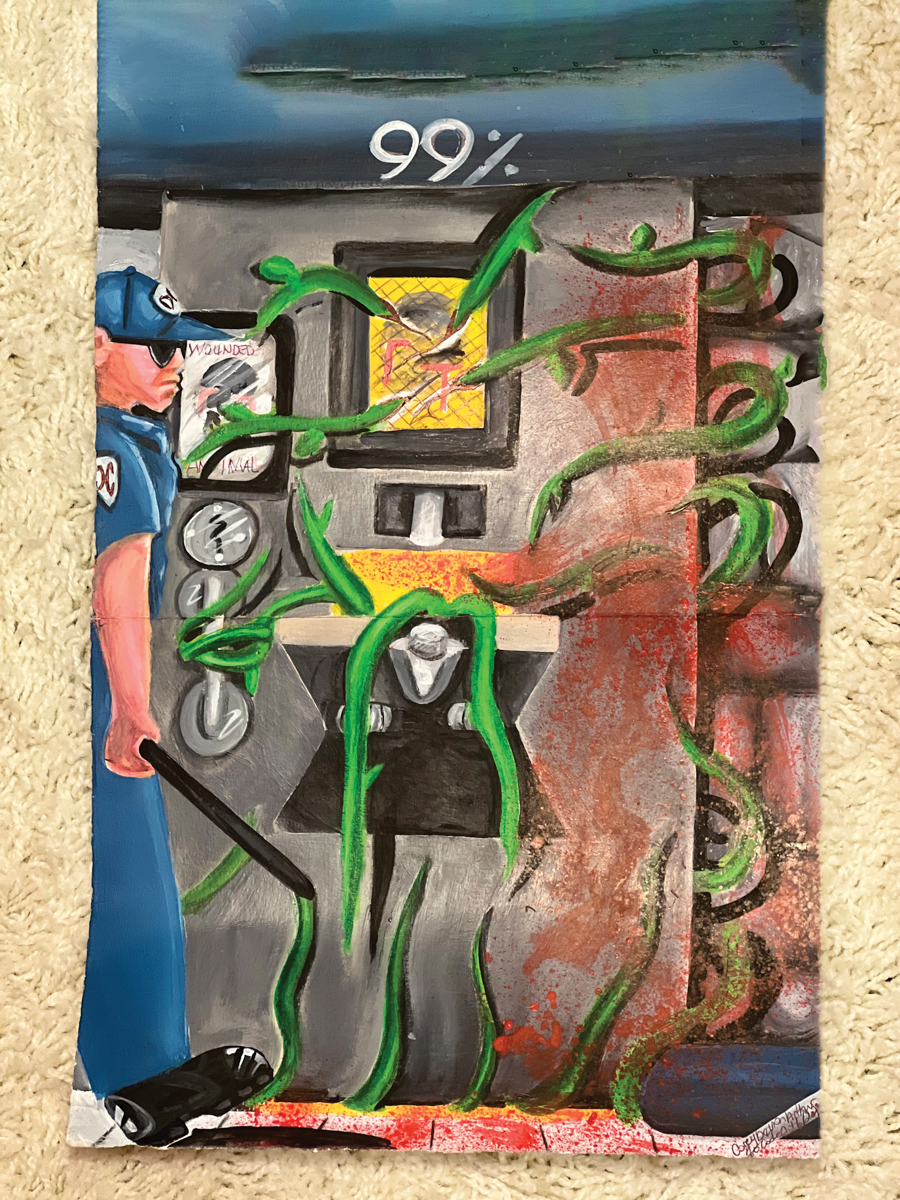
A huge thank you to currently incarcerated artist Corey Devon Arthur for creating this breathtaking series of paintings and illustrations for the Life In The Hole: Zine Compilation.
If you are interested in getting in contact with Corey, please contact him through Securus (Corey Devon Arthur 98A7146) as well asdincoreart@gmail.com.
Many thanks to our free world allies who made thisproject possible: Emily Nonko, Judy Meikle, and Chris Thee Comic.


.jpg)
.jpg)
.jpg)
.jpg)
.jpg)